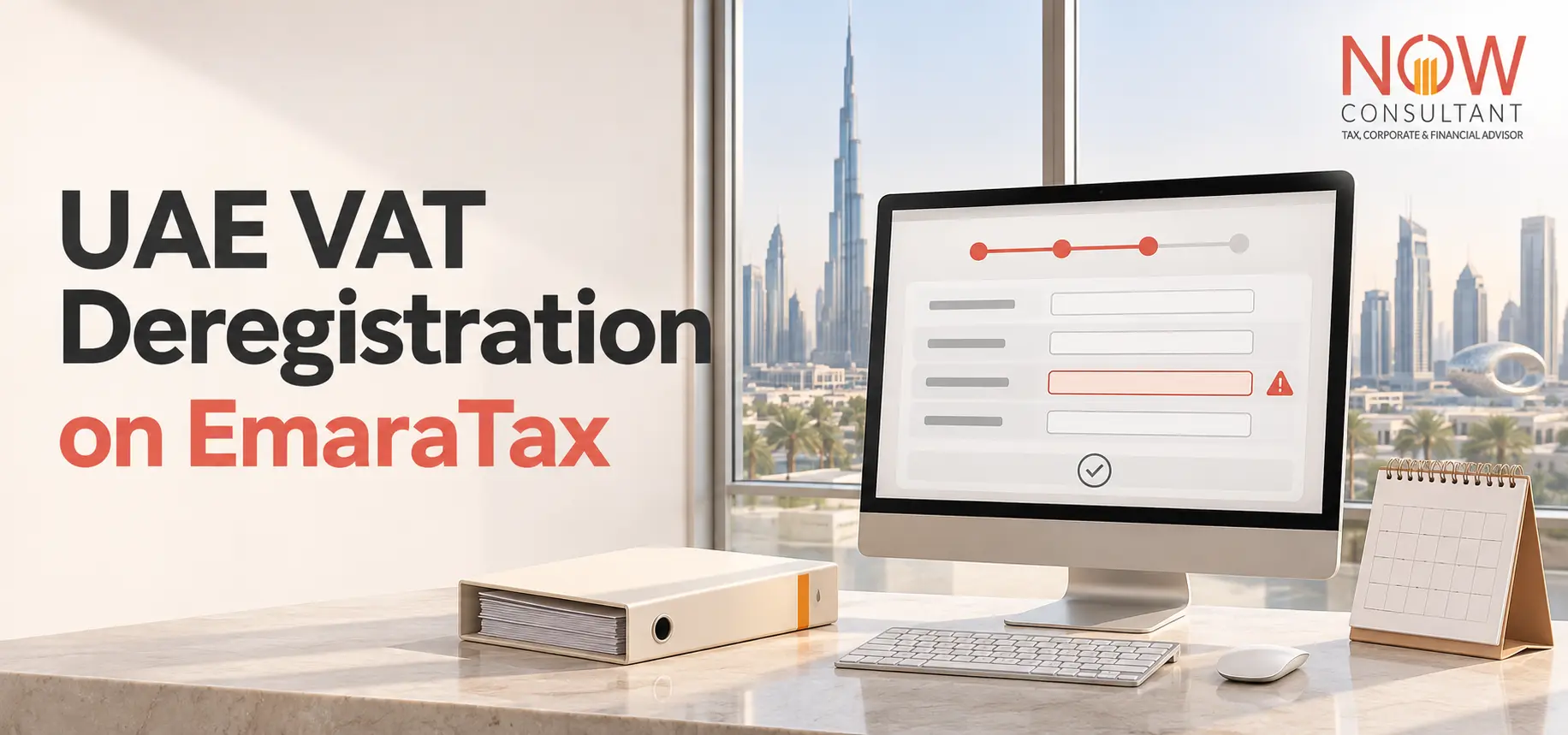
To deregister for VAT through EmaraTax, confirm your eligibility, establish the relevant date, reconcile your records and submit an application with supporting documents. Complete outstanding returns, settle liabilities and follow the FTA’s final-return instructions. Submission alone does not cancel your registration, and recordkeeping obligations continue afterward.
VAT Deregistration in UAE: The Key Figures
VAT deregistration ends a person’s VAT registration from an effective date accepted or determined by the Federal Tax Authority. It does not automatically close the business, cancel its trade licence or remove outstanding tax obligations.
For an owner winding down operations, the challenge is connecting the application to the financial records. The reason selected, turnover schedules, cessation evidence and final return should explain the same position.
| Item | Position to understand |
| Government application fee | AED 0; professional fees are separate |
| Mandatory application deadline | Article 14(1) specifies 20 business days; see the published-source discrepancy explained below |
| Current FTA processing estimate | 30 business days after receiving a completed application |
| Final return and payable tax | Generally within 28 days of the effective deregistration date |
| Late deregistration application | AED 1,000, recurring monthly, capped at AED 10,000 |
| Standard VAT records | Generally five years after the relevant tax period |
| Capital-asset records | At least ten years |
| Real-estate VAT records | Fifteen years after the relevant tax period |
These periods serve different purposes. The application deadline is your filing obligation; the processing estimate concerns the FTA’s review. Neither replaces the final-return deadline.
Successful deregistration requires more than completing the online form. The figures and supporting evidence must establish why the registration should end and what remains payable or refundable.
Establish Whether Deregistration Is Mandatory or Optional
VAT deregistration eligibility depends on more than a quiet month of sales. Review your taxable supplies, qualifying expenses, expected activity and original registration basis before applying.
When an application is mandatory
Mandatory deregistration can arise when taxable supplies stop or when the relevant supplies fall below the voluntary registration threshold without continued eligibility under the expense-based registration test.
For cessation, distinguish permanent closure from a temporary interruption. An unfinished project, seasonal slowdown or delayed customer payment does not necessarily demonstrate that taxable activity has ended.
Review signed contracts, remaining orders and expected supplies. Record why the proposed cessation date represents the business position rather than simply the date management decided to close.
For example, a company may approve liquidation while continuing to complete existing customer work. Its closure resolution is relevant evidence, but the remaining activity must also be considered.
How the threshold tests work
The voluntary registration threshold is AED 187,500. The mandatory registration threshold is AED 375,000.
However, taxable expenses can matter when assessing continued registration eligibility. Low revenue alone may not establish that deregistration is mandatory where qualifying expenditure supports continued voluntary registration.
The Executive Regulation also addresses expected supplies or taxable expenses over the next 30 days. Assess that forward-looking position using available evidence, including purchase commitments and customer contracts.
Prepare a rolling twelve-month calculation. Do not substitute the current financial year or the latest quarterly return unless it covers the required period.
Separate standard-rated and zero-rated supplies from exempt and outside-scope transactions. Zero-rated sales are still taxable supplies; treating them as exempt can distort the eligibility review.
When voluntary deregistration may be available
Article 22 permits an application where taxable supplies during the preceding twelve months were below the mandatory threshold, subject to the applicable conditions.
A separate restriction applies to persons registered voluntarily under Article 17: Article 23 prevents an application within twelve months of registration. Check the original registration basis before assuming an immediate exit is available.
Remaining registered may still make commercial sense. Consider recoverable purchase VAT, customer expectations and realistic growth plans before choosing voluntary cancellation.
A business with low current revenue but substantial planned purchases should assess the financial consequences carefully. Reduced administration does not necessarily outweigh the loss of input VAT recovery.
A practical decision matrix
| Business position | Appropriate next review |
| Taxable operations have permanently stopped | Establish cessation evidence and application timing |
| Supplies are below AED 187,500 | Review taxable expenses and expected activity before concluding |
| Supplies are between the two thresholds | Assess voluntary eligibility and commercial consequences |
| Original voluntary registration is under twelve months old | Examine the statutory restriction |
| One branch closes while other operations continue | Review the registration covering the whole taxable person |
Understand FTA-Initiated Deregistration
An application by the business is not the only route. The FTA can initiate deregistration under specified conditions where maintaining registration may prejudice the integrity of the tax system.
Article 14(bis) addresses circumstances including failure to meet registration requirements and failure to submit or complete a required application. It also requires the Authority to verify ineligibility before deregistering the person.
This does not mean that every dormant company, nil return or refund position automatically leads to cancellation.
Respond to correspondence and keep registration information accurate. Waiting for the FTA to act is not a substitute for reviewing your own obligations.
An Authority-initiated decision also does not erase earlier liabilities or prevent a future registration obligation from arising.
Documents Required for VAT Deregistration in UAE
Prepare an evidence pack around the actual reason for applying. A business continuing below the threshold should not be treated as though it has entered liquidation.
The VAT deregistration requirements in UAE are therefore best approached through a working checklist, followed by the specific documents requested for the selected application category.
Records to assemble before starting
Bring together the trade licence, registration details, authorised-signatory information, relevant accounts and turnover schedules.
Also prepare a record of submitted returns, outstanding balances, significant assets and unresolved correspondence. These help the person completing the application identify contradictions before submission.
Keep working calculations linked to their source records. A spreadsheet total should be traceable to invoices and accounting entries rather than entered as an unsupported estimate.
Check that the legal name, licence details and registration information are consistent across the application and attachments.
Closing or liquidating a business
Depending on the selected reason and legal circumstances, relevant evidence includes licence cancellation, liquidation documents, a board resolution and cessation records.
Build a dated chronology covering the closure decision, last taxable supplies, asset disposals and licensing steps. If these events happened on different dates, explain the difference instead of forcing them into one date.
Reconcile the closing accounts before signing declarations. Outstanding customer balances, supplier invoices and asset transactions should have an explained treatment.
Continuing with lower turnover
Prepare monthly supplies and expense schedules, sales ledgers, relevant bank statements and management accounts.
A forecast declaration should reflect available orders and commitments. Where the FTA requires a signed or stamped declaration, ensure the authorised person understands the figures and period covered.
The official checklist distinguishes lower-turnover applications from closure, branch and duplicate-registration cases. It also requests turnover information from actual registration in relevant categories, so a twelve-month schedule may not satisfy every request.
Do not provide a cancelled licence as though it is universally required when the business remains active.
Restructuring, branches and VAT groups
A share sale does not necessarily change the registered legal person. A business transfer, merger, branch closure and tax-group amendment can require different treatment.
Useful working records may include transaction agreements, amended licences, group details and an explanation of which person continues the activity.
For sole establishments, review other businesses operated by the same natural person. Closing one licence may not end that person’s taxable activities.
Do not submit a cancellation request merely because the ownership or trading name changed.
Make the documents easy to review
Use descriptive filenames, readable scans and consistent dates. Separate the reason explanation from detailed schedules, and identify supporting attachments within the explanation.
A short document index helps your team locate evidence when questions arrive. Avoid uploading unrelated papers simply to make the file appear comprehensive.
Follow the VAT Deregistration Process in UAE Through EmaraTax
The online form records the application. Eligibility, reconciliations and supporting evidence should already be substantially prepared before you begin.
Step 1: Review the account and outstanding work
Check filing history, tax balances, administrative penalties, refund positions and open requests.
Identify missing returns and errors requiring correction. Plan settlement of outstanding amounts, but do not allow unresolved housekeeping to push a mandatory application beyond its deadline.
An application and completed deregistration are different stages. Liabilities and final obligations can prevent completion even after a request has been submitted.
Assign responsibility for each outstanding action so that preparing the application does not leave earlier compliance work unattended.
Step 2: Select the correct taxable person
Sign in through the current EmaraTax authentication process. Open the taxable person associated with the registration being reviewed.
Where your profile covers several entities, compare the legal name and registration details carefully. Avoid creating a duplicate profile because the intended account is not immediately visible.
Keep account access and authorisation under the business’s control. Confirm that the registered email and telephone details remain accessible during the review.
Step 3: Open the deregistration application
From the selected person’s dashboard, locate the VAT tile, open Actions and select De-Register or the equivalent current label.
Read the instructions and review any information-update prompts before proceeding.
The FTA’s user manual describes this route and explains that the application sections depend on the selected deregistration basis. Screen wording can change, so follow the live instructions where they differ.
Step 4: Choose the reason and establish the dates
Select the category matching your evidence: cessation, reduced supplies or another applicable basis.
Distinguish the eligibility date, submission date and requested effective date. They are not automatically identical.
For example, management may approve closure before the final customer work is delivered. The last invoice date may also differ from the date of supply. Explain these events using records rather than choosing the most convenient date.
Never alter a date simply to make an application appear timely.
Step 5: Complete the financial schedules
Enter the required supplies and expenses in UAE dirhams using the current fields or available templates.
Reconcile amounts to the accounts and filed returns. Explain legitimate differences, including timing, credit notes or transaction classifications.
Bank receipts are not automatically taxable turnover. Shareholder funding and customer deposits require proper classification.
Retain the reconciliation supporting the submitted figures so that another team member can understand how they were prepared.
Step 6: Review, submit and preserve evidence
Check attachments, contact details, signatory authority, declarations and totals before submission.
Save the application reference, submitted version and acknowledgement. A saved draft is not proof that the FTA received a completed application.
If the business participates in the Tourist Refund Scheme, coordinate that separate deregistration requirement. The manual indicates that VAT processing cannot be completed until the relevant scheme deregistration is completed.
Separate the Application Deadline From the Review Timeline
The timeline for deregistration involves several clocks, each requiring its own diary entry.
Application deadline: Article 14(1) of the consolidated Executive Regulation specifies 20 business days after a mandatory deregistration event.
Published discrepancy: The FTA service card currently states 30 business days for mandatory applications. This conflicts with the regulation reviewed for this article. Follow the earlier statutory timeframe when planning a new application. Obtain clarification for an affected existing case rather than assuming an extension.
Official references: See Article 14(1) of the VAT Executive Regulation and the application-deadline wording on the FTA VAT deregistration service page.
Review estimate: The current service card gives 30 business days from receipt of a completed application. Additional information can lead to a further review period after resubmission.
The FTA’s published service details explain the processing estimate, possible additional review time and the deadline for submitting the final return and paying the tax due.
Final return: The general deadline is 28 days from the effective date, corresponding to the end of the final tax period. Check the actual return and notification.
Use the applicable business-day definition and UAE public holidays when calculating deadlines. Do not copy an old article’s weekend assumptions.
Keep a timeline showing the triggering event, supporting evidence, submission, requests, responses and final obligations. Assign responsibility for monitoring it, particularly during staff departures or company closure.
Read Application Statuses Before Taking Action
Status labels describe stages, not interchangeable forms of approval.
| Status or message | Practical response |
| Draft | Complete and submit; retain the acknowledgement |
| Under review | Monitor correspondence and account obligations |
| Resubmit or additional information requested | Address each comment and resubmit |
| Reviewed or pre-approved | Read the remaining actions and decision carefully |
| Rejected | Examine the stated reason before deciding the next route |
| Completed deregistration | Preserve the final confirmation and certificate |
The FTA’s published status explanations distinguish these stages. Some legacy descriptions differ, so the detailed notification matters more than assumptions about a label.
For a returned application, create a response table listing the query, explanation and attachment. Correct inconsistent schedules together.
Re-uploading unchanged documents without addressing the question is unlikely to resolve it. Where a request is unclear, seek clarification instead of guessing what evidence the reviewer expects.
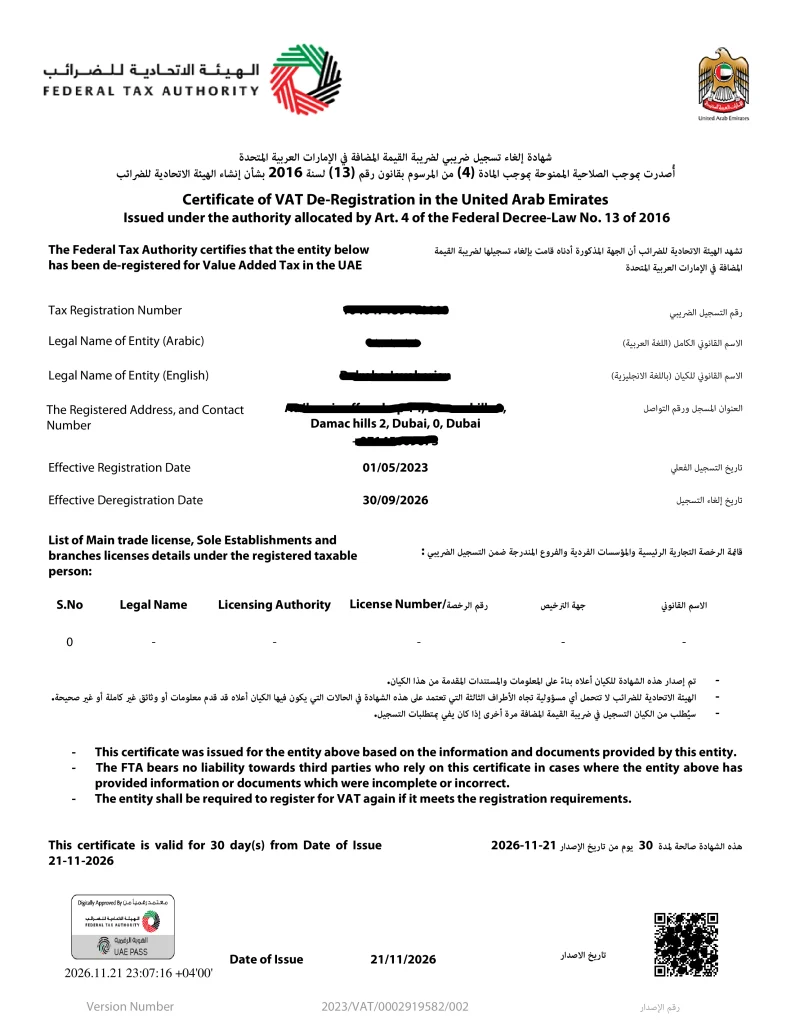
What an FTA VAT Deregistration Certificate Shows
The certificate below provides a practical example of completed VAT deregistration. It identifies the registered person and confirms that their VAT registration has ended. It also distinguishes the effective deregistration date from the certificate’s issue date, helping readers understand what to check when reviewing their own document.
Understand Government Fees and Professional Charges
The government application is free. The cost of professional assistance depends on the work needed around it.
Ask whether the quotation includes eligibility review, reconciliations, application preparation, FTA responses, final-return support and completion follow-up.
Backlog bookkeeping, voluntary disclosures, refund applications or disputes may require separate work. Agree those boundaries before proceeding.
Outstanding VAT and penalties are not service fees. A low application-preparation quote does not mean the tax account has no remaining exposure.
A useful quotation explains the deliverables, required client records, exclusions and payment terms. It should also distinguish the adviser’s responsibilities from decisions reserved for the Authority.
Calculate Penalties and Use the Correct Review Route
The late-application penalty is AED 1,000 for late submission, recurring on the same date monthly, up to AED 10,000. This penalty is set out in Table 1, item 4 of Cabinet Decision No. 40 of 2017 and its amendments.
That cap applies to this violation. It does not cap every penalty or tax amount on the account. Separate charges can arise from late returns, unpaid tax or incorrect reporting.
Check the assessment’s reason, notification date and calculation against your submission evidence.
Where you dispute an official decision, reconsideration and penalty waiver are different routes. A reconsideration request explains why the decision should be changed; a waiver request must meet its own eligibility conditions.
The FTA’s reconsideration guidance states that a request generally must be submitted within 40 business days of the original decision. A separate mechanism allows an extension request under specified conditions.
Prepare a factual chronology, relevant legal grounds and supporting proof. Illness, technical difficulties or an agent’s involvement should be documented rather than presented as automatic grounds for relief.
Penalty waiver applications are subject to prescribed controls. Submitting one does not guarantee cancellation of the amount assessed, and it should not be assumed to suspend unrelated obligations.
Hidden Traps That Can Leave the Application Unfinished
Retained stock and assets can create a final adjustment
A business may stop selling while still owning inventory, equipment or other assets.
Review the VAT treatment of what remains immediately before deregistration. The law addresses deemed supplies on deregistration and exceptions, including circumstances where related input tax was not recovered.
Do not assume every asset automatically attracts an identical charge. Consider recovery history, exemptions, capital-asset adjustments and applicable thresholds.
Prepare an asset-by-asset schedule showing description, acquisition records, input VAT treatment, disposal or retention and the proposed calculation. Reconcile it with the ledger and physical records.
A fully depreciated accounting value does not, by itself, resolve the VAT treatment.
Stopping returns too early creates another problem
Submitting the application is not permission to ignore returns appearing on the account.
Monitor regular and final periods, including periods with no reportable transactions. Establish who will respond if a return becomes due while the application remains unresolved.
The final return should be reconciled separately rather than treated as a routine repetition of the previous quarter.
Refundable balances need a separate plan
A credit balance does not necessarily produce an automatic bank refund. Reconcile it to returns, recoverable input tax and payments, then use the appropriate refund process.
The FTA identifies VAT311 as the VAT refund route and requests supporting tax reports and invoices where applicable.
Refund rights also have time limits. Amendments effective from 2026 introduced a general five-year framework with specified exceptions and transitional provisions. Review older balances promptly rather than assuming they remain available indefinitely.
Keep suitable banking arrangements available while lawful settlements and refunds remain outstanding.
An expired licence does not close the VAT account
Licence expiry, cancellation and actual cessation are different events.
A company may have stopped trading before expiry, continued activity afterward or retained contracts and assets. Establish the facts and reconcile them with the proposed application basis.
Resolve access problems early if the authorised signatory or account administrator is leaving.
Corporate Tax requires a separate assessment
VAT cancellation does not cancel Corporate Tax registration. Review its own cessation event, filing obligations and deregistration requirements.
Company liquidation and licence cancellation should therefore be coordinated with both tax workstreams. A VAT certificate alone does not demonstrate that all closure obligations have been completed.
A Worked Example: An Active Business With Lower Revenue
Consider a hypothetical consultancy with AED 290,000 of relevant taxable supplies during the preceding twelve months. Its original voluntary registration is eighteen months old, and it intends to keep operating.
Management should assess voluntary eligibility, expected activity and the financial consequences of leaving the VAT system. The figures do not establish that immediate cancellation is mandatory.
Before applying, the team would reconcile monthly revenue, examine qualifying expenses, review upcoming contracts and assess outstanding returns.
If the consultancy instead permanently ceased activity, the application basis and supporting chronology would change. Retained assets and final obligations would still require attention.
This example illustrates the review process, not a guaranteed approval outcome.
After Approval: Update Operations and Preserve Records
Use the confirmed effective date to update invoicing and accounting settings. Do not select the submission date as an automatic cut-off.
Stop presenting the business as VAT-registered for subsequent supplies. Update relevant templates, online checkout settings, customer records and business communications. Preserve historical invoices accurately rather than removing their original information.
VAT treatment follows the relevant supply and adjustment rules, not simply the date cash is collected. Review later receipts, refunds and credit notes relating to earlier transactions before posting them.
Retain ordinary VAT records for the applicable five-year period. Capital-asset records have an at-least-ten-year requirement, while real-estate VAT records have a fifteen-year period. Audits, disputes and other provisions can extend retention.
Official recordkeeping references: See Article 3 of the Tax Procedures Executive Regulation for general retention periods and extensions, Article 60 of the VAT Law for capital-asset records, and Article 71 of the VAT Executive Regulation for real-estate VAT records.
Create an accessible archive containing ledgers, returns, invoices, calculations, correspondence, payment evidence and final confirmation. Export information before cancelling accounting software.
Deregistration does not prevent future registration. If activity resumes or the relevant tests are met again, review the registration obligation promptly.
Complete the Process With NOW Consultant
A supported application begins with understanding why the business is leaving the VAT system and ends with checking the remaining obligations.
Now Consultant can review eligibility, reconcile the relevant records, prepare supporting schedules and assist with the agreed EmaraTax application and follow-up work.
Share your business position, registration history, recent accounts and any FTA correspondence through the agreed document-sharing process. The team can then explain the scope, outstanding information and professional fee.
Whether you are closing, restructuring or continuing at a smaller scale, the objective is the same: an application supported by consistent evidence, with responsibilities assigned through to completion.