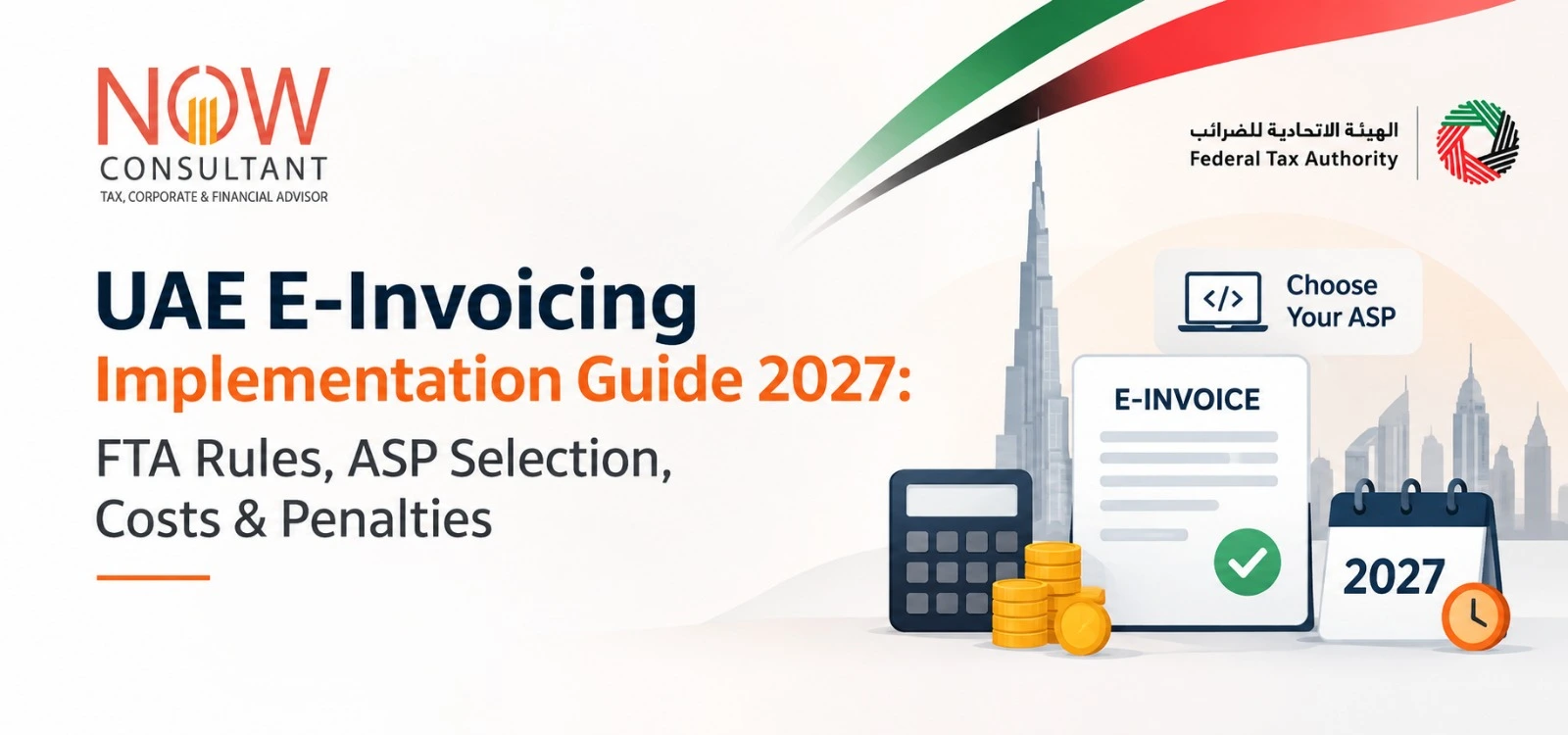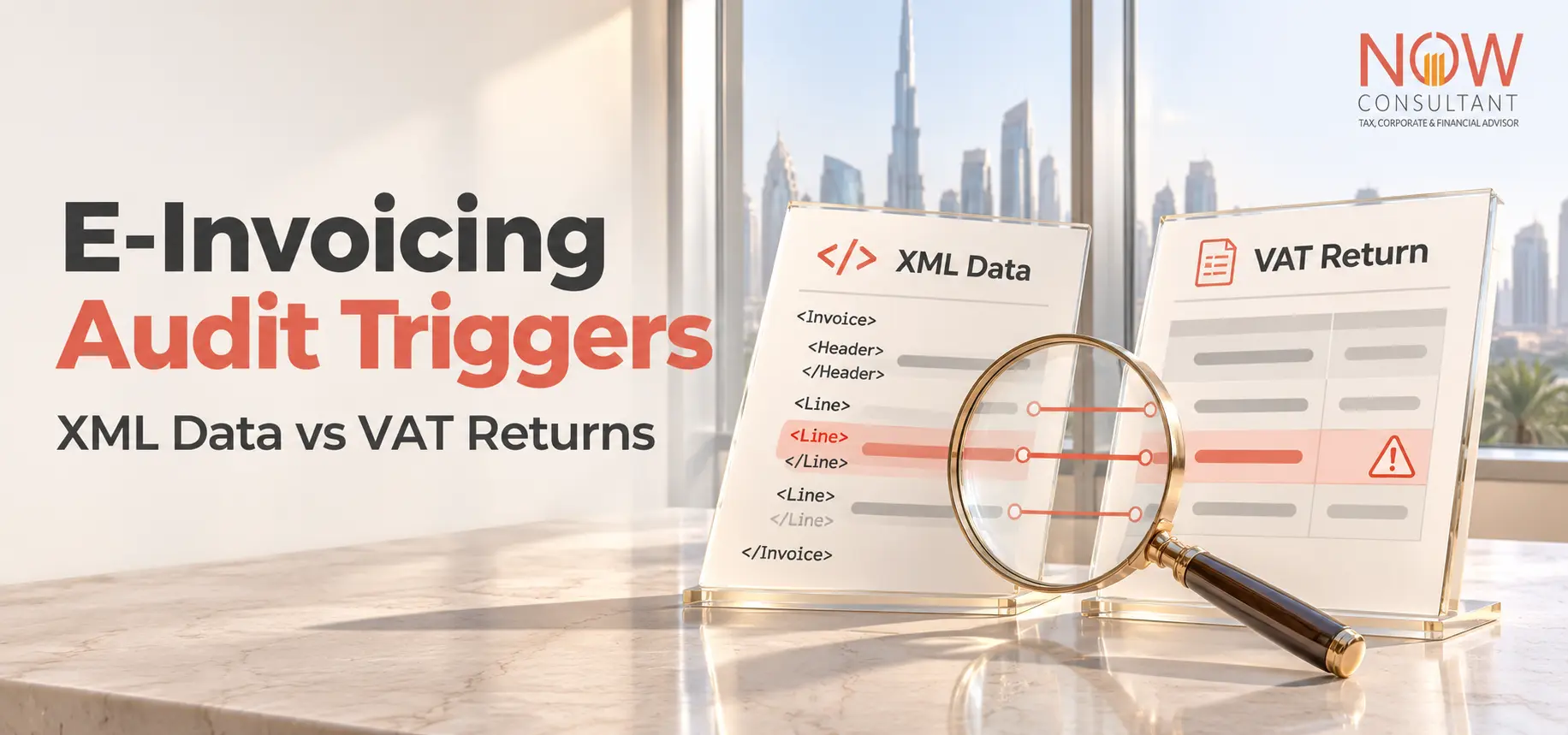
In the UAE, e-invoicing gives the FTA your invoice data before you file your VAT return. Advisers warn that any gap between that XML data and your return can prompt a query. Phase 1 E-Invoicing audit triggers became mandatory on 1 January 2027 for businesses with revenue of AED 50 million or more. The safest fix is a monthly check that matches your invoices, your ledger and your return.
Want to know which phase you are in and how ready you are today? Send us one month of invoice data on WhatsApp (+971 52 214 6392) for a free check.
For years, a VAT return was the first time the FTA saw your sales and purchases. E-invoicing changes that order, because structured invoice data reaches the FTA while you are still trading. Your return then arrives as a second version of the same story. If the two versions differ, someone will want to know why.
This guide covers the main e-invoicing audit triggers in the UAE and how to fix each one. A tax consultant in Dubai can run these checks before your first live invoice goes out. Our accounting services in Dubai team can also set up the monthly match for you.
Which e-invoicing phase are you in?
| Group | Provider appointment | Mandatory from |
| Phase 1: revenue of AED 50 million or more | Deadline was 30 October 2026 | 1 January 2027 |
| Phase 2: revenue below AED 50 million | 31 March 2027 | 1 July 2027 |
| Government entities | 31 March 2027 | 1 October 2027 |
| Voluntary adopters and pilot businesses | Not applicable | From 1 July 2026 |
Dates come from advisory summaries of the UAE e-invoicing programme, so confirm them with the Ministry of Finance. If you missed the Phase 1 provider deadline, appoint an accredited provider immediately. Reported penalties for late implementation make delay costly, so act now.
How does the FTA see your invoices before you file?
Under the five-corner model, your supplier’s accredited provider validates each invoice and reports the tax data to the FTA. Your buyer’s provider relays the same data again from the receiving side. So the FTA can hold both sides of a transaction in near real time.
PDFs, scans and emailed documents do not count as e-invoices under the new rules. You remain accountable for the accuracy and timeliness of the data, even when a provider sends it.
Which five audit triggers hide in your XML data?
Advisory commentary says one unmatched invoice may trigger a query, while repeated mismatches may invite a full audit.
| Trigger | What the XML shows | What goes wrong in the return | Fix |
| Timing gaps | An invoice dated near period end | It is booked in the wrong period | Match invoice dates to the tax period |
| Missed credit notes | A credit note issued or received | The return still shows the full invoice | Net credit notes on both sides |
| Wrong tax treatment | A zero-rated invoice | It is reported as standard-rated, or the reverse | Check the tax code on every line |
| Duplicate invoices | The same UUID appears twice | Input VAT is claimed twice | Check UUIDs before each filing |
| Unmapped ledger codes | An invoice with no ledger mapping | It falls outside your VAT workings | Map every code before go-live |
What does a three-way match look like?
Match three records every month: your ledger, your e-invoice register and your draft VAT return.
| Source | Output VAT (AED) |
| Ledger | 52,000 |
| E-invoice register | 54,500 |
| Draft VAT return | 52,000 |
| Difference to investigate | 2,500 |
In this example, the register shows AED 2,500 more output VAT than the return. The cause could be an invoice posted to the wrong period or booked under a wrong tax code. Finding it before you file means your return and your invoice data tell the same story. These numbers are made up to show the method, not real client figures.
What does a mismatch cost?
Penalty rules were updated again in November 2026, so confirm current amounts with the Ministry of Finance. Reports describe AED 5,000 for an initial violation, plus AED 5,000 for each month it continues. Total penalties are reportedly capped at AED 50,000 in any 12 consecutive months.
Those fines cover e-invoicing breaches, while VAT return errors fall under the separate VAT penalty rules. Reported 2026 VAT rules set AED 500 for a first incorrect return, waived if corrected in time. Unpaid tax and later-found errors can cost far more, including 1% a month on disclosed differences.
What should you do before go-live? Seven steps
- Confirm your phase and your appointed provider with written proof.
- Run a data gap check on tax codes, TRNs and invoice fields.
- Map every ledger code to the correct VAT treatment before testing begins.
- Test live invoices end to end with your provider before the deadline.
- Reconcile ledger, invoice register and return every month before filing.
- Net credit notes on both the sales and purchase sides.
- Write down who owns each check and who reviews it.
How can accounting support help?
Outsourced accounting services can run the monthly three-way match, so mismatches are fixed before you file. Accounting supervision services add a qualified reviewer who signs off every return. Reliable financial reporting shows which ledger accounts feed each line of your VAT workings.
If past periods are messy, backlog accounting services clean them up first. Our VAT services in Dubai team handles the filing and any FTA query that follows.
Frequently asked questions
When does e-invoicing become mandatory in the UAE for my business? Phase 1 starts on 1 January 2027 for businesses with revenue of AED 50 million or more. Other businesses are reported to follow from 1 July 2027.
Can the FTA see my invoices before I file my VAT return? Yes, accredited providers report invoice tax data to the FTA in near real time. So the data is already there when your return arrives.
What causes mismatches between e-invoice data and a VAT return? Common causes are timing differences, missed credit notes, wrong tax treatment, duplicates and unmapped ledger codes.
Are PDF invoices still valid once e-invoicing starts for my business? For in-scope transactions no, because PDFs, scans and emails are not treated as e-invoices.
What are the penalties for not complying with UAE e-invoicing? Reports describe AED 5,000 for an initial violation and AED 5,000 for each month it continues. Confirm current amounts, because the rules were updated in November 2026.
Do small businesses need to worry about e-invoicing data matching? Yes, because Phase 2 businesses are reported to start on 1 July 2027. Starting your reconciliation habit early costs little and avoids a rush later.
Get your e-invoicing readiness and mismatch check
Now Consultant has supported UAE businesses since 2015 with tax, accounting and compliance work. Our team includes FTA-registered tax agents and an FTA-certified Head of Tax. We hold a 5.0 Google rating, and we helped a client clear an AED 10,000 penalty.
Tell us your revenue band, your accounting system and your appointed provider, if you have one. We will confirm your phase, test one month of data and list the gaps. Our accounting and advisory services then keep the monthly match running after go-live. Our accounting services in Dubai team can start your readiness check this week.