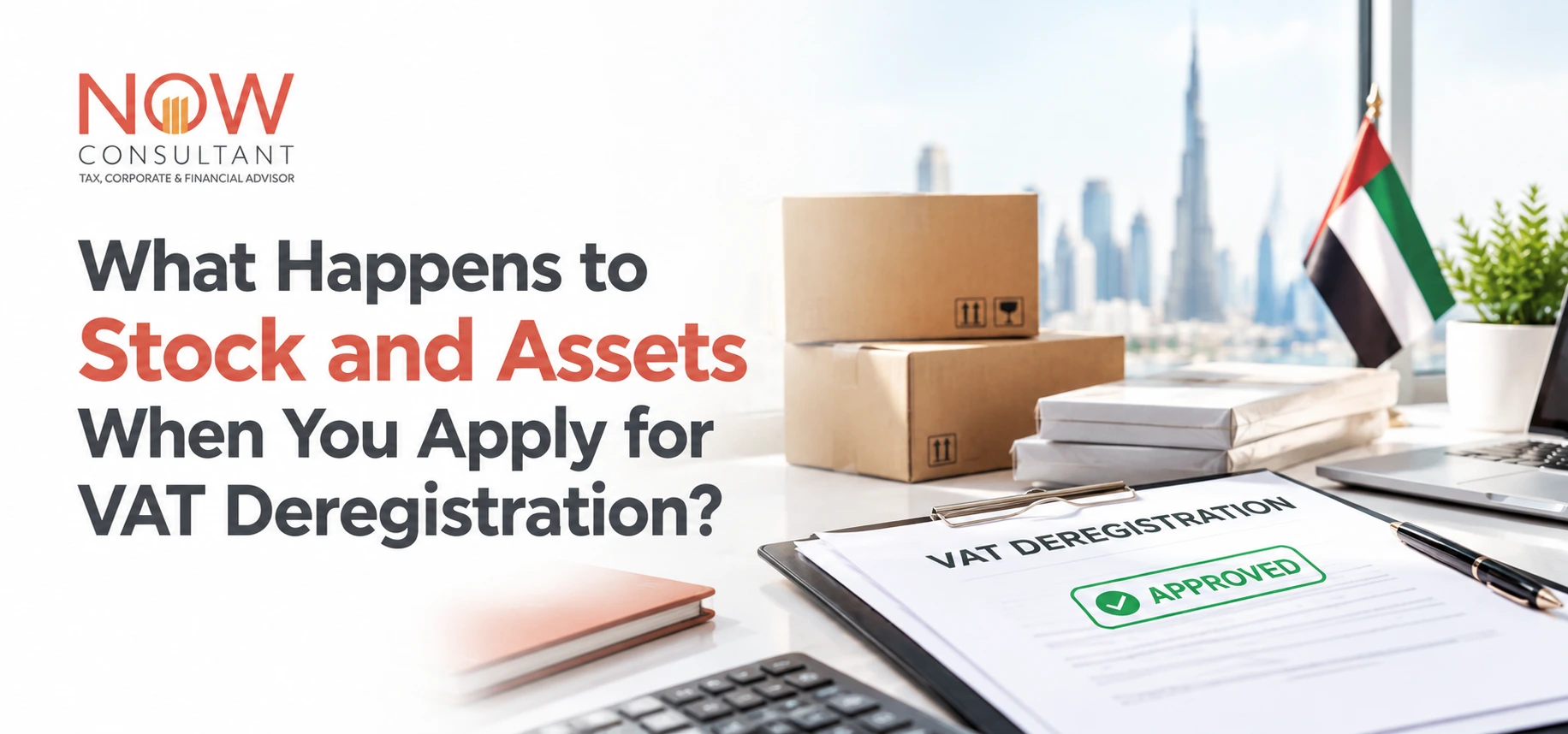
You may owe VAT on them. When you deregister, the FTA generally treats stock and business assets that you still hold, and on which you claimed input VAT, as if you sold them to yourself on the deregistration date. You pay 5% output VAT on their market value in your final VAT return. Many owners only find out when the final bill arrives.
Most people think deregistration is a form. Log in, tick a box, wait for the certificate. Then the form asks for the value of your stock and capital assets, and the questions start.
If you’re searching for VAT deregistration help in Dubai, you probably have one of two problems. Either you’re closing the company, or your sales have dropped and you want out of VAT. Either way, your unsold stock, vehicles, computers and equipment matter. This guide shows what the rule says, how to work out the bill, and how accounting services in Dubai can fix it before you file.
Why does deregistration create a tax bill on stock?
Because you already got the VAT back. When you bought stock and equipment, you probably claimed the VAT as input tax. That was fair, because you planned to use them in a taxable business.
Once you leave the VAT system, the FTA wants that VAT back on whatever you still own. So the law treats your remaining goods and capital assets as supplied at market value on the deregistration date. This is called a deemed supply. You report the output VAT in your final return.
Which items are usually affected?
| Item | Deemed supply? | What to do |
| Unsold stock where you claimed input VAT | Generally yes | Value at current market value |
| Equipment, vehicles, computers where you claimed input VAT | Generally yes | Value at current market value, not original cost |
| Items where you never claimed input VAT | Generally no | Keep proof that no VAT was claimed |
| Goods sold to customers before the cut-off date | No, normal sale | Charge VAT as usual and report it in the return |
| Business sold as a going concern | Rules differ | Take advice before you file |
Always check your own case. The exact treatment depends on what you bought, what you claimed and what you plan to do with the business.
What does it cost? A worked example
A trading company wants to deregister. It holds:
- Unsold stock bought for AED 200,000. Market value today is AED 150,000.
- Office equipment and a van. Market value today is AED 50,000.
The deemed supply is based on today’s market value, not what you paid.
- Stock: AED 150,000 × 5% = AED 7,500
- Equipment and van: AED 50,000 × 5% = AED 2,500
- Output VAT in the final return: AED 10,000
Now imagine the owner forgot to declare it. The FTA could assess the tax later and add penalties. A few minutes with a tax consultant in Dubai would have cost far less.
When must you apply?
It depends why you’re deregistering.
- Mandatory: You’ve stopped making taxable supplies or closed the business. You should apply within 20 business days. Missing that deadline can mean an AED 10,000 penalty.
- Voluntary: Your taxable sales over the past 12 months were below AED 375,000, and you don’t expect to go above it. Some businesses stay registered to recover input VAT, so think before you leave.
Because the deadline runs from the event, don’t wait until the shop is empty. Start the stock count early.
How do you deregister without a nasty surprise? Five steps
- Clear your history. File every VAT return and settle any penalties before you apply.
- Count and value your stock and assets. Use current market value. This is the document advisers say is most often missing.
- Work out the output VAT. List each item, check whether input VAT was claimed, and add 5%.
- Apply on EmaraTax. The form asks for the reason, the cessation date, your last 12 months of taxable supplies and the value of stock and capital assets.
- File the final VAT return. Include the deemed supply and pay any VAT due. Then wait for the FTA’s confirmation and effective date.
The FTA aims to review within about 20 business days, though in practice it can take longer.
Can you reduce the bill legally?
Sometimes. You can talk to your adviser about:
- Selling stock to customers before you deregister, at normal VAT rules, so there’s less left to deem
- Whether a sale of the business as a going concern changes the treatment
- Whether to stay registered for a short while to recover VAT on final costs
Be careful. Dumping stock at a very low price just before the cut-off can invite questions. Plan the timing with a professional.
How can accounting support help?
Clean records make the final return quick. Backlog accounting services update your stock and fixed-asset registers. Outsourced accounting services can keep your books ready while you wind down. Accounting supervision services add a reviewer who checks the final return before it goes in, and clear financial reporting shows exactly what you hold.
If you’re closing the company, you may also need an audit and a final corporate tax position. Our VAT services in Dubai team can handle all of it in one plan.
Get your final VAT bill estimated before you apply
Now Consultant has supported UAE businesses since 2015. Our team includes FTA-registered tax agents and an FTA-certified Head of Tax. We hold a 5.0 Google rating, and we’ve helped a client clear an AED 10,000 penalty.
Send us your stock list, asset list and last VAT return. We’ll tell you whether you can deregister, what the deemed supply could cost, and the cleanest way to file. Our accounting and advisory services cover valuation, the final return and company closure support in one team. Our accounting services in Dubai team can start this week.