Your supplier sends an invoice. Your team pays it. The accountant records the VAT and moves on. For years, that was a complete process.
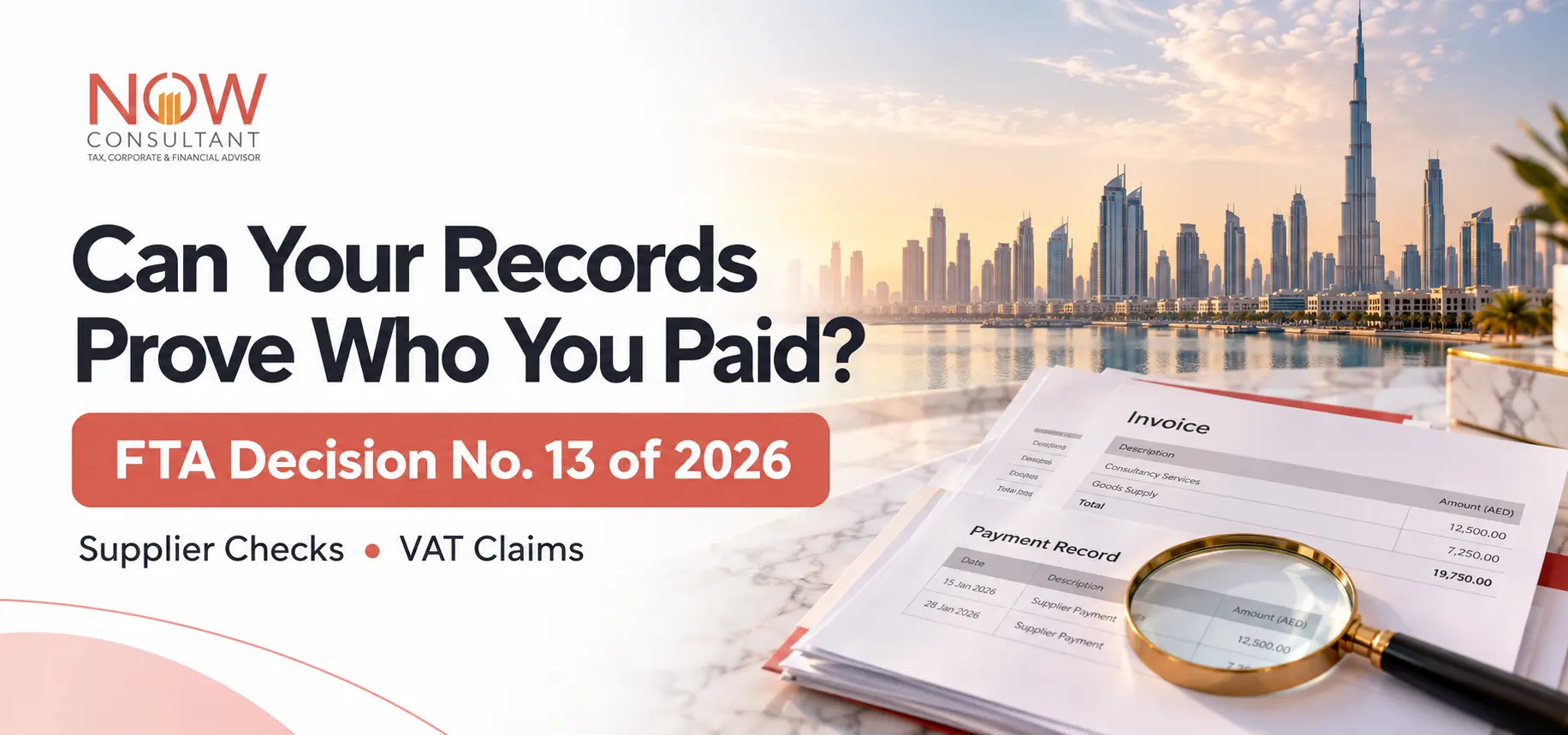
It isn’t anymore. FTA Decision No.13 of 2026 came into effect on 1st October 2026 and modifies the threshold requirements for deducting input VAT. Valid invoice and TRN no longer tell the whole story. The records will now need to include information on who the supplier is, what has been purchased and how it has been paid.
This guide demystifies the rules and provides tips on preparing your business.
What FTA Decision No. 13 of 2026 Actually Does
The decision provides guidance on the steps a VAT registered business needs to take and record before claiming input VAT. It implements Article 54(bis) of the UAE VAT Law, which empowers the UAE Federal Tax Authority to deny a deduction in case of a supply of goods that can be connected to cases of VAT evasion.
This can be compared to “know your supplier” for VAT. You should establish that the supplier is authentic, that this transaction is commercially reasonable, and that that payment was routed in a verifiable manner.
The focus is not so much on whether or not to get ready, since the rule has already come into effect. It has to do with whether or not the information you have is the information you need.
Why Missing Checks Can Cost You Input VAT
Article 54(bis) works on two levels. The FTA must refuse a deduction if you knew the supply was connected to evasion. It may also refuse if you should have known, based on the circumstances.
This is the part many businesses overlook. Several advisory firms note that skipping the required checks can itself support a “should have known” finding. In that situation, the FTA does not need to prove you were aware of any fraud. The missing verification does the work for them.
That makes documentation your main protection. A clean file shows you acted carefully. An empty file leaves your VAT claim exposed.
What Your Business Must Verify
Subject to the decision’s exceptions, four areas need checking.
Supplier identity. Verify the supplier’s incorporation and get the proper identification of the authorised representative. If the supplier is one person, identification and an in-person or virtual meeting is required.
Business presence. Verify the business address and ensure it is appropriate for the business activity. If a consultancy lists a warehouse address or a trading company doesn’t have any premises, this should give it some thought.
Transaction details. Consider the commercial motive for the purchase, the price and if goods/services are within the suppliers scope of business. Confirm the authenticity and ownership for goods.
Payment arrangements.Use electronic payment. If cash payment is to be used, a documented commercial reason, meeting the applicable thresholds and verifiable evidence are required.
The AED 375,000 Threshold
There is a closer examination of larger relationships. Additional checks apply if the total purchase from a single supplier exceeded AED 375,000 in the past 12 months, or if the purchase of this supplier is expected to exceed AED 375,000 in the next 12 months.
This includes verification by a bank and checking out the reputation of the supplier.
These include confirmation from a bank and a review of the supplier’s reputation. Firm alerts describe this as confirming that the supplier holds a bank account with a UAE bank and assessing publicly available information.
Supplier verification is needed at the start of the relationship. It must be repeated if you have not verified the supplier within the previous 12 months. Your supplier list should therefore carry a “last verified” date for each vendor.
Are Small Purchases Exempt?
There is a limited exception. Individual supplies below AED 10,000, excluding VAT, may be treated as outside the verification measures.
The exception has a catch. Not applicable where the purchases from that supplier in the last 12 months are more than AED 100,000 or are anticipated to be more than AED 100,000 in the next 12 months.
This is a basic example. Once you purchase the office supplies from one vendor each month, you purchase 6,000 AEDs’ worth of office supplies. The total amount for the year is AED 72,000 but each batch is less than AED 10,000. This is still within the AED 100,000 limit, therefore the exception is valid. The monthly batches are AED 9,000, which results in annual batches surpassing AED 100,000 and making them eligible for verification.
Check on these totals on a regular basis rather than on a single invoice.
How to Create a Supplier File that Works
It’s best to include verification as part of the onboarding or purchase approval process, so that it occurs before the payment is made, not before the VAT return.
Make a folder for each supplier.. It should hold:
- Identification and company documents
- Your verification records, with dates
- Contracts and purchase orders
- Invoices and delivery records or service confirmations
- Payment evidence
The file should let anyone follow the transaction from purchase to payment.
Take an equipment purchase. The folder should show who sold the machine, what was delivered, and how you paid. For a consultancy engagement, the signed agreement and evidence of the work performed explain the invoice.
Good financial reporting depends on this kind of structure. When your books and your supplier files agree with each other, an FTA query becomes a quick answer instead of a long search.
Who Should Own Which Step
A written policy with responsibilities must be created for the decision.Most businesses end up splitting the work three ways.
- Documents are gathered by procurement and identity and premises are checked.
- Operations verifies that goods have been received and/or service was provided.
- Finance checks the payment method, watches the thresholds, and signs off the VAT deduction.
A brief checklist that is used each and every time is better than a stack of documents collected in a hurry before filing.
It’s something many growing companies don’t have the capacity for. The document checks and threshold tracking can be done within outsourced accounting services, thus without the need of a bigger in-house team. Others retain the work in-house and introduce accounting supervision services, with which a competent reviewer reviews the files monthly. A tax consultant Dubai can also review your draft policy before the FTA ever sees it.
Mistakes We See Most Often
- Treating a valid TRN on an invoice as proof that verification is done
- Verifying suppliers once and never refreshing the check after 12 months
- Judging each invoice separately and missing the yearly totals that trigger the AED 100,000 and AED 375,000 limits
- Paying in cash without writing down why
- Holding documents in different inboxes and folders, so nobody can assemble a full file quickly
- Having no written policy at all
The majority of these are process issues, not product failures. They are correctable if there is a clear process and ownership. .
Final Thoughts
FTA Decision No. 13 of 2026 shifts VAT recovery from “do I hold an invoice?” to “can I show I knew who I was dealing with?” Businesses that answer yes with a tidy file will claim input VAT with confidence. Businesses that cannot are taking an avoidable risk.
If you want a second pair of eyes on your supplier checks, Now Consultant can review your current process, help you write the policy, and set up files your team can maintain. Our accounting services in Dubai and accounting and advisory services cover both the VAT side and the day-to-day bookkeeping behind it. Reach out before your next VAT return, not after.