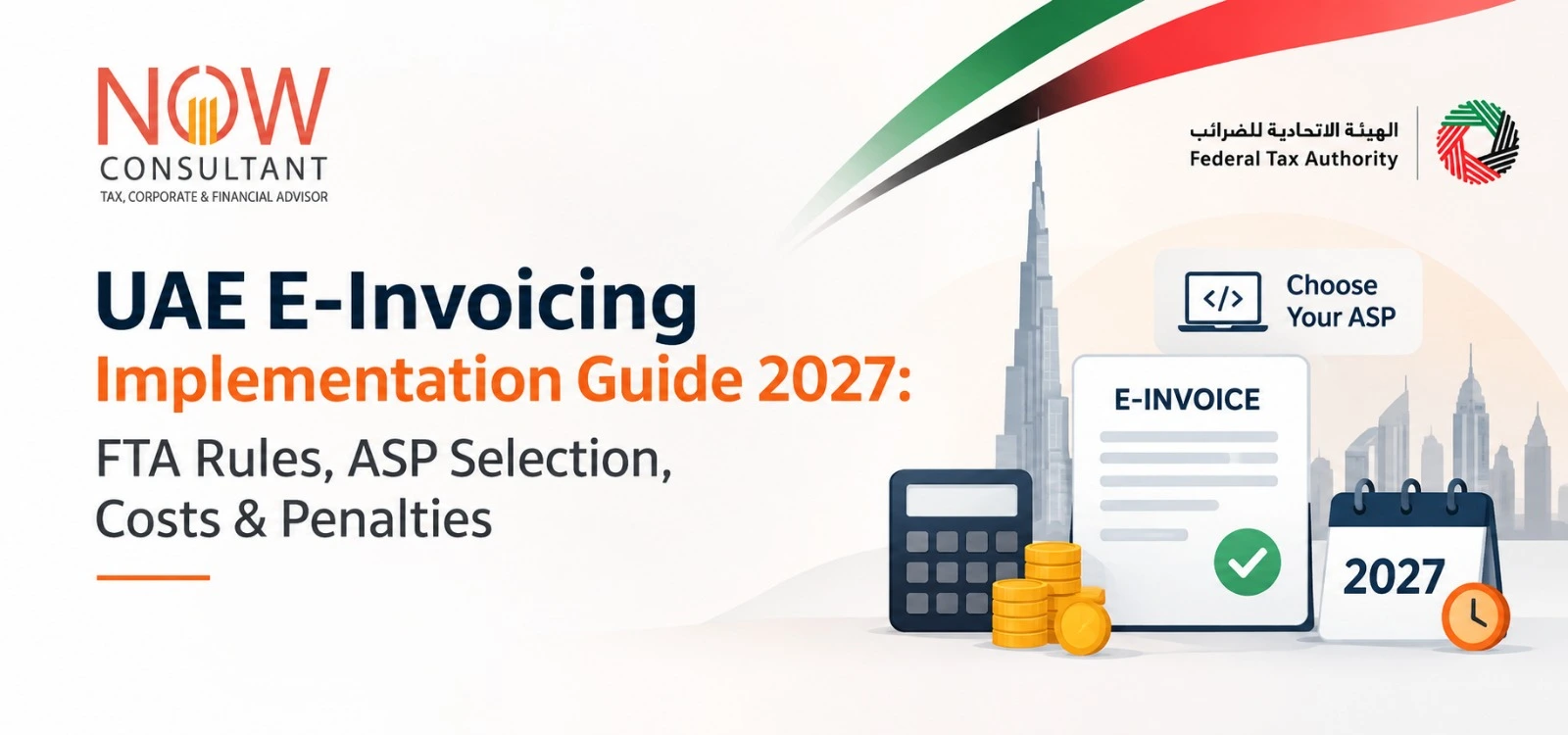
UAE e-invoicing is becoming mandatory in 2027, changing how businesses issue invoices, receive supplier bills and report transaction information to the Federal Tax Authority (FTA).
Whether you run a small business in Dubai, manage a free zone company or operate a large organisation, preparing for e-invoicing is essential.
Businesses with annual revenue of AED 50 million or more must implement e-invoicing by 1 January 2027. Businesses below AED 50 million must comply by 1 July 2027. However, both groups must appoint an Accredited Service Provider (ASP) before their implementation dates.
Preparing for the new system involves reviewing your accounting software, updating customer information, selecting an accredited provider and testing electronic invoices.
This UAE e-invoicing implementation guide explains the latest deadlines, FTA requirements, software options, implementation process, costs and penalties to help your business prepare.
What Is E-Invoicing in the UAE?
E-invoicing is a digital system that allows businesses to create, send and receive invoices in a format that accounting software can read and process automatically.
Unlike traditional invoices prepared in Excel, Word or PDF, electronic invoices contain structured information that can move directly between business systems.
The UAE introduced e-invoicing to improve tax reporting, reduce manual errors and make invoicing more efficient.
How Is E-Invoicing Different From a PDF Invoice?
Many UAE businesses currently prepare invoices using accounting software and email them to customers as PDF attachments.
However, a PDF invoice alone does not meet the UAE’s electronic invoicing requirements.
Electronic invoices use a structured format called PINT AE, allowing different accounting systems to exchange invoice information automatically.
For example, when a Dubai trading company sells goods worth AED 10,000 plus VAT to another company, its accounting software can create an electronic invoice and send it through the approved network.
The customer’s system can receive the invoice details directly, reducing manual data entry and errors.
How Does UAE E-Invoicing Work?
The UAE uses a five-corner system based on the international Peppol network.
The process is straightforward:
- The supplier creates an invoice using accounting software.
- The supplier’s Accredited Service Provider checks and sends it.
- The customer’s Accredited Service Provider receives the invoice.
- The customer receives it through the connected accounting system.
- The required tax information is reported electronically to the FTA.
Businesses do not normally send individual invoices directly to the FTA. Their appointed providers manage the electronic exchange and reporting.
UAE E-Invoicing Deadlines for 2027
The Ministry of Finance has introduced mandatory e-invoicing in phases based on annual business revenue.
| Business category | ASP appointment deadline | Mandatory implementation |
| Annual revenue of AED 50 million or more | 30 October 2026 | 1 January 2027 |
| Annual revenue below AED 50 million | 31 March 2027 | 1 July 2027 |
| Government entities within scope | 31 March 2027 | 1 October 2027 |
The voluntary e-invoicing programme began on 1 July 2026, allowing businesses to start using the system before their mandatory dates.
Has the UAE E-Invoicing Deadline Been Extended?
Yes, but the extension applies to the ASP appointment deadline for large businesses.
Under Ministerial Decision No. 66 of 2026, companies with annual revenue of AED 50 million or more were given until 30 October 2026, instead of 31 July 2026, to appoint an ASP.
Their mandatory implementation date remains 1 January 2027.
As of 17 November 2026, no further official extension of the mandatory 2027 implementation dates has been announced.
Companies that missed the appointment deadline should review their compliance position and begin onboarding immediately.
How Is Annual Revenue Calculated?
Annual revenue generally refers to the gross income earned during the most recent accounting period, based on financial statements or other acceptable records.
The AED 50 million threshold determines the implementation phase. It does not automatically exempt smaller businesses.
Which Businesses Must Comply With UAE E-Invoicing?
UAE e-invoicing mainly covers business-to-business (B2B) and business-to-government (B2G) transactions.
B2B transactions occur when one business supplies goods or services to another. B2G transactions involve supplies to government entities.
The requirements may apply to mainland companies, free zone businesses, trading companies, manufacturers and professional service providers.
E-Invoicing for Small Businesses and Free Zones
Small businesses must generally comply when they conduct transactions covered by the rules, even if they issue only a few invoices monthly.
Free zone companies are also not automatically exempt.
Businesses operating in DMCC, IFZA, JAFZA, ADGM and other UAE free zones should review their transactions and implementation deadlines.
A company benefiting from a Corporate Tax free zone incentive may still need to issue electronic invoices.
Businesses Without VAT Registration
E-invoicing is not limited to VAT-registered companies.
A business that is not registered for VAT may still need to issue commercial electronic invoices for covered transactions.
Such businesses should confirm their Tax Identification Number (TIN) and related registration requirements before implementation.
B2C Transactions and Special Cases
Sales made directly to individual consumers, known as business-to-consumer (B2C) transactions, are currently excluded from mandatory electronic invoice issuance.
However, a business making only consumer sales may still need to receive electronic invoices from its UAE business suppliers. It should therefore review whether an ASP is required for receiving invoices.
Other transactions requiring special attention include:
- Exports: Electronic invoices may be required for sales to overseas business customers.
- Imports: Imports covered by the relevant reverse charge rules for Concerned Goods and Concerned Services are excluded.
- Domestic reverse charge: Certain supplies involving precious metals, stones and electronic devices may require specific invoice treatment.
- VAT tax groups: Transactions between members of the same UAE VAT Tax Group are temporarily excluded for 24 months from 1 January 2027.
- Financial services: Certain exempt and zero-rated financial services are excluded under the applicable rules.
Businesses with international transactions or different VAT treatments should review the requirements before configuring their software.
Common E-Invoicing Challenges and Practical Solutions
Many companies already use accounting software, but this does not automatically mean their systems are ready for UAE e-invoicing.
The most common challenges involve incorrect business information, VAT errors and unsuitable invoicing systems.
Incorrect Customer and Supplier Information
Missing legal names, incorrect tax identifiers or incomplete addresses may cause electronic invoice rejections.
Solution: Review customer and supplier records, verify tax information and correct missing details before implementation.
Incorrect VAT Rates
An accounting system may incorrectly classify a transaction or apply the wrong VAT rate.
For example, a business may accidentally charge 5% VAT on a qualifying zero-rated export.
Solution: Review VAT settings and assign the correct tax treatment to each product or service.
Manual Invoices and Excel Records
Businesses preparing invoices manually may not have systems capable of producing the required electronic format.
Solution: Assess whether existing software can be upgraded or whether a compatible accounting platform would be more suitable.
Invoice Rejections and Currency Errors
Invoices may fail because of incorrect tax information, missing details or foreign currency calculation errors.
Solution: Test common invoice types, review AED conversion requirements and establish procedures for correcting rejected invoices.
E-Invoicing Readiness Assessment for UAE Businesses
Before appointing a provider, businesses should review their existing accounting systems and invoicing processes.
A practical readiness assessment should cover:
- Implementation deadline: Confirm the company’s mandatory compliance date.
- Accounting software: Check whether the current system supports UAE e-invoicing.
- Customer records: Review business names, addresses and tax information.
- VAT settings: Verify tax rates and special transaction categories.
- Invoice volume: Estimate monthly sales invoices, supplier bills and credit notes.
- Internal procedures: Identify employees responsible for preparing, approving and monitoring invoices.
Completing this assessment helps identify problems early and reduces last-minute implementation difficulties.
Mandatory E-Invoice Fields and VAT Requirements
The Ministry of Finance’s updated guidance identifies 51 required data fields for electronic Tax Invoices and 49 for commercial Electronic Invoices.
These requirements cover supplier and customer information, transaction details and applicable taxes.
Important details include invoice numbers, dates, legal business names, tax identifiers, product descriptions, quantities, VAT rates and invoice totals.
Foreign currency invoices must also include the required AED values.
Businesses do not need to enter every field manually. Compatible accounting software can generate much of this information once properly configured.
However, companies remain responsible for maintaining accurate records and applying the correct VAT treatment.
Best E-Invoicing Software in the UAE: How to Choose
Choosing suitable accounting software is an important part of implementation.
Businesses may already use Zoho Books, Tally, QuickBooks, Xero, Odoo, SAP, Oracle or Microsoft Dynamics.
The best solution depends on business size, transaction volume, accounting requirements and existing systems.
Accounting Software vs. Accredited Service Provider
Accounting software records business transactions, prepares invoices and maintains financial information.
An Accredited Service Provider connects the business to the approved electronic invoicing network.
| Accounting software | Accredited Service Provider |
| Creates invoices and credit notes | Exchanges electronic invoices |
| Records sales and purchases | Validates and transmits invoice data |
| Maintains accounting records | Connects suppliers and customers |
| Prepares financial and VAT reports | Supports reporting to the FTA |
Some providers combine accounting software and accredited invoicing services, while others require separate connections.
Zoho Books for UAE E-Invoicing
Zoho Books is one option for UAE small and medium-sized businesses.
Zoho Software Trading LLC is a Ministry of Finance-accredited e-invoicing service provider, and Zoho Books supports electronic invoice exchange through the Peppol network.
Its features include:
- Creating and sending electronic invoices
- Receiving electronic supplier bills
- Managing electronic credit notes
- Checking invoice status and validation errors
- Maintaining VAT and accounting records
- Connecting to the approved invoicing network
Businesses already using Zoho Books may not need another accounting platform.
Eligible users can appoint Zoho Software Trading LLC as their ASP through EmaraTax and complete the required connection within Zoho Books.
Now Consultant uses Zoho Books in its accounting services and assists businesses with software configuration, record preparation and e-invoicing implementation support.
Using Tally, QuickBooks, Xero or Other ERP Systems
Businesses using other accounting platforms should first check whether their existing software can connect to an accredited ASP.
Changing software is not always necessary.
Some systems offer direct integrations, while others require additional technical connections.
Before migrating, compare compatibility, total implementation costs and ongoing support requirements.
How to Select an Accredited Service Provider in the UAE
Appointing an ASP is an important requirement for businesses covered by the e-invoicing system.
Ministerial Decision No. 168 of 2026 introduced an updated accreditation framework, replacing the earlier pre-approval process.
Businesses should select a provider with full Ministry of Finance accreditation.
Before signing an agreement, consider:
Accreditation: Confirm that the provider appears on the official Ministry of Finance list.
Software compatibility: Check whether it connects with your existing accounting or ERP software.
Invoice exchange: Ensure the system supports both incoming and outgoing invoices and electronic credit notes.
Pricing: Compare subscriptions, transaction allowances, integration fees and additional invoice charges.
Technical support: Check the support available for connection issues and rejected invoices.
Data security: Understand how electronic invoice information is stored and protected.
The right provider should meet regulatory requirements without creating unnecessary operational difficulties.
Documents Required for UAE E-Invoicing Setup
Before starting onboarding, businesses should prepare:
- Valid UAE trade licence
- Registered business name and address
- VAT registration certificate, if applicable
- Corporate Tax registration details, if applicable
- Tax Identification Number
- Authorised representative details
- EmaraTax account access
- Accounting software information
- Estimated monthly invoice volume
- Updated customer and supplier records
The selected ASP may request additional documents for verification or technical setup.
Step-by-Step UAE E-Invoicing Implementation Process
A successful implementation requires planning, accurate information and testing before the mandatory date.
Step 1: Review Existing Invoicing Practices
Identify how invoices are currently created, approved, sent and stored.
Review sales invoices, supplier bills, credit notes, exports and transactions requiring special VAT treatment.
Step 2: Update Business Information
Correct incomplete customer records, tax identifiers, addresses and product descriptions.
Review invoice settings and VAT categories to reduce errors.
Step 3: Select an Accredited Service Provider
Compare providers based on accreditation, software compatibility, charges and technical support.
Complete the service agreement and required verification procedures.
Step 4: Complete EmaraTax Onboarding
Log in to EmaraTax and follow the relevant procedures to appoint or authorise the selected ASP.
Complete the connection process according to the provider’s instructions.
Step 5: Configure Accounting Software
Update invoice fields, VAT settings and approval procedures.
Businesses using customised ERP systems may require additional software integration.
Step 6: Test Electronic Invoices
Test standard invoices, zero-rated transactions, exports, foreign currency invoices and credit notes.
Confirm that invoices pass validation and reach the intended customer.
Correct any errors before going live.
Step 7: Train Employees and Go Live
Train finance staff to prepare invoices, monitor transmission status and handle corrections.
Once testing is complete, the business can begin live electronic invoicing.
Implementation may take several weeks for companies using compatible cloud software. Businesses with complex ERP systems may require additional time.
E-Invoice Errors, Corrections and the 14-Business-Day Rule
Electronic invoices may fail validation because of missing information, incorrect tax details or formatting errors.
If an invoice fails before successful transmission, the business should correct the information and submit it again.
However, an invoice already successfully issued through the network should not simply be edited or deleted.
Where changes are required, businesses should issue an appropriate electronic credit note and, if necessary, a replacement invoice.
Under Ministerial Decision No. 197 of 2026, electronic invoices and electronic credit notes must generally be issued and transmitted within 14 business days from the date of the business transaction, subject to the applicable requirements.
VAT-registered businesses must also continue following the relevant VAT invoicing deadlines. The electronic invoicing rule does not automatically extend those deadlines.
Issuing invoices promptly and monitoring failed submissions can help businesses avoid unnecessary compliance problems.
UAE E-Invoicing Implementation Costs and Provider Charges
Implementation costs depend on the existing accounting software, selected ASP, invoice volume and technical requirements.
There is no single fixed government implementation fee for every business.
| Cost component | What it covers |
| Accounting software | Subscription, upgrade or migration |
| ASP services | Electronic invoice exchange and reporting |
| Setup and configuration | Invoice fields, tax settings and data preparation |
| Software integration | Connecting accounting software with the ASP |
| Testing and training | Invoice validation and employee training |
| Ongoing support | Technical assistance and compliance reviews |
Are the First 100 E-Invoices Free?
Under Ministerial Decision No. 168 of 2026, accredited providers must offer each end-user 100 free electronic invoice exchange and reporting services per year, starting from the date of the end-user agreement.
However, this does not mean accounting software, migration, integration or professional setup services are free.
For example, Zoho Books offers 100 free e-invoicing transactions on eligible Professional and higher paid UAE plans. Additional transaction packs are available for purchase.
Businesses should request a quotation covering all relevant setup and ongoing charges before selecting a provider.
Small businesses can often reduce costs by using compatible existing software rather than purchasing an entirely new accounting system.
UAE E-Invoicing Penalties and Non-Compliance Risks
Failure to meet mandatory e-invoicing requirements can result in administrative penalties.
Cabinet Decision No. 173 of 2026 introduced an updated penalty framework, replacing Cabinet Decision No. 106 of 2025.
| Violation | Administrative penalty |
| Failure to implement e-invoicing or appoint an ASP by the deadline | AED 5,000 initially, plus AED 5,000 for each month or part of a month of continued non-compliance, capped at AED 50,000 within 12 consecutive months |
| Failure to issue and transmit an electronic invoice | AED 100 per invoice, capped at AED 5,000 per calendar month |
| Failure to issue and transmit an electronic credit note | AED 100 per credit note, capped at AED 5,000 per calendar month |
| Failure to notify the ASP of changes to registered tax information | AED 250 per day or part of a day, capped at AED 5,000 per calendar month |
The updated rules removed the previous separate penalty for failing to notify the FTA of an electronic invoicing system failure.
However, businesses should maintain records of technical problems and resolve them promptly.
To reduce compliance risks, companies should appoint their ASP on time, complete software testing and train employees before mandatory implementation.
Electronic Invoice Recordkeeping and Ongoing VAT Compliance
E-invoicing does not replace regular accounting, VAT return filing or tax recordkeeping requirements.
Businesses must maintain accurate electronic invoices, credit notes and supporting records for the periods required under UAE tax legislation.
The general tax record retention period is five years, while certain records may require longer retention.
The October 2026 amendments removed the earlier requirement to store electronic invoice data specifically within the UAE.
However, records must remain secure, accessible and available to the FTA when requested.
After implementation, businesses should regularly compare electronic invoices with accounting records and VAT returns.
This includes reviewing sales, purchases, credit notes, foreign currency transactions and VAT calculations.
UAE E-Invoicing Implementation Support by NOW Consultant
Preparing for e-invoicing can be challenging, particularly for businesses already managing daily accounting, VAT compliance and customer payments.
NOW Consultant provides accounting services, tax and e-invoicing implementation support to help UAE businesses prepare for the new requirements.
Our services include:
E-Invoicing Readiness Assessment
We review invoicing processes, accounting records, VAT treatment and implementation deadlines to identify areas requiring improvement.
Accounting Software Preparation
We assist with software configuration, customer and supplier information, invoice settings and tax records, including support for Zoho Books users.
Accredited Service Provider Selection
We help businesses compare suitable accredited providers, assess compatibility and understand implementation and ongoing charges.
Integration and Testing Support
We coordinate with software providers and ASPs to support system setup, electronic invoice testing and implementation.
Ongoing Accounting and VAT Compliance
After implementation, we assist with accounting reconciliations, VAT compliance, invoice corrections and financial reporting.
Our objective is to help businesses establish a practical electronic invoicing process that supports daily operations and meets the applicable requirements.
Get Your Business Ready for UAE E-Invoicing
Is your business prepared for the 2027 e-invoicing deadline?
NOW Consultant can help you review your accounting software, identify compliance gaps, select a suitable ASP and prepare for implementation.
Whether you use Zoho Books, another accounting platform or a customized ERP system, our team can guide you through the preparation and implementation process.
Contact NOW Consultant today for a UAE e-invoicing readiness assessment and implementation consultation.
Official UAE E-Invoicing Regulations and References
This article is based on UAE Ministry of Finance electronic invoicing guidance and the relevant legislation, including Ministerial Decisions Nos. 243 and 244 of 2025, as amended; Ministerial Decisions Nos. 66, 168 and 197 of 2026; and Cabinet Decision No. 173 of 2026.
For official guidance and updates, visit the UAE Ministry of Finance E-Invoicing Portal.