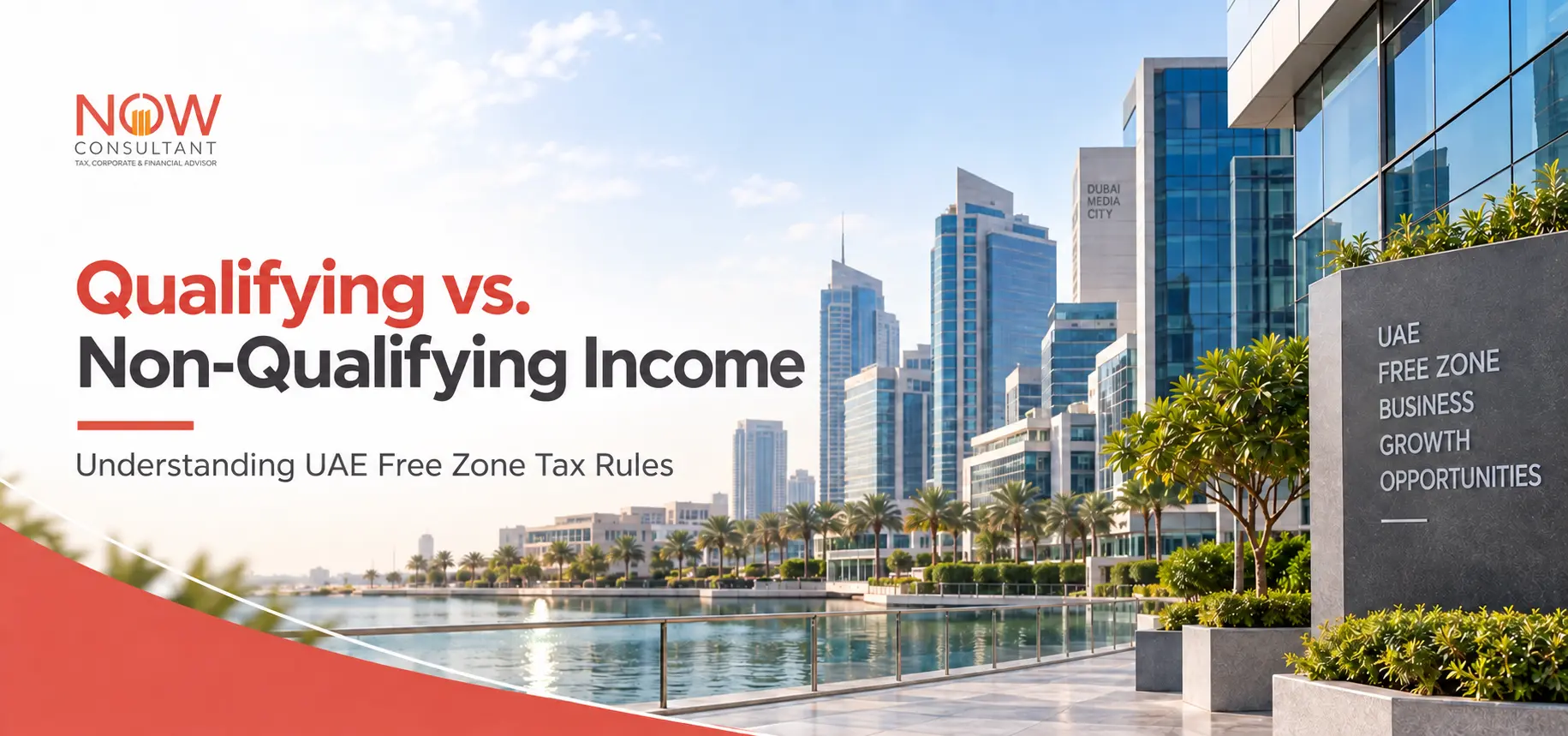
Calling the UAE free zone system a “0% tax zone” is a mistake nearly every new founder makes. It isn’t accurate. The 0% rate doesn’t attach to your license. It attaches to a specific slice of income called Qualifying Income UAE, earned by a business that meets a closed list of conditions in every single tax period.
Get the classification wrong, and the cost isn’t small. One misclassified transaction can push your entire income, not just the bad slice, onto the standard 9% rate. This guide breaks down exactly how qualifying and non-qualifying income actually work in 2026, with real examples.
The Core Rule Most Founders Get Backwards
Under Article 18 Federal Decree-Law 47 of 2022, a free zone person is still a taxable person. The 0% rate is available only to a Qualifying Free Zone Person UAE, and only on the income that qualifies. Everything else, including income earned by a perfectly compliant QFZP, gets taxed at the standard 9% rate above AED 375,000.
This single point resolves most of the confusion floating around free zone marketing. Your license doesn’t decide your tax rate. Your income classification does, transaction by transaction.
What Counts as Qualifying Income
Cabinet Decision No. 100 of 2023 sets the framework, while the current Qualifying Activities list UAE comes from Ministerial Decision No. 229 of 2025. Activities that generate Qualifying Income include:
- Manufacturing and processing of goods
- Trading of Qualifying Commodities, including metals, energy, agriculture, and industrial chemicals
- Holding of shares and securities
- Ship operation and reinsurance
- Regulated fund and wealth management
- Headquarters and treasury services provided to related parties
- Aircraft financing and leasing
- Logistics and distribution from a Designated Zone
- Certain activities ancillary to the ones above
Income from qualifying intellectual property nexus activities can also qualify, but only under a modified nexus approach tied to actual R&D spending. Marketing IP, like trademarks and brand names, is explicitly excluded from this benefit.
What Counts as an Excluded Activity
Some activities are always taxed at 9%, no matter how strong your QFZP status is otherwise. These Excluded Activities free zone categories include:
- Transactions with natural persons, with narrow carve-outs for shipping, fund management, wealth management, aircraft financing, and reinsurance
- Banking activities
- Insurance activities, apart from reinsurance
- Finance and leasing activities outside qualifying treasury functions
- Ownership or exploitation of immovable property, other than commercial property transactions between free zone persons
If your income falls into one of these categories, it stays at 9% regardless of how the rest of your business is structured.
The B2C Trap Almost Nobody Expects
This is the detail that catches new founders off guard the most. Selling to individual consumers, meaning natural persons rather than businesses, generally falls outside Qualifying Income entirely. A free zone company running a direct-to-consumer e-commerce operation may find that its core revenue stream is non-qualifying by default, regardless of how the transaction is structured or where the customer is located.
This matters because plenty of free zone marketing implies broad 0% coverage, when the actual rule depends heavily on who’s on the other side of the transaction.
The De Minimis Buffer: Your Safety Margin
Not every stray transaction destroys your QFZP status. The de minimis threshold UAE allows a small amount of non-qualifying revenue without penalty, capped at the lower of AED 5 million or 5% of total revenue in a tax period.
This buffer exists precisely so that one occasional non-qualifying sale doesn’t wipe out an otherwise compliant year. But it’s a buffer, not a workaround. Cross that threshold, and the consequences apply to the entire entity, not just the excess portion.
What MD 229 of 2025 Actually Changed
Ministerial Decision No. 229 of 2025 superseded the previous Ministerial Decision No. 265 of 2023 from 1 June 2023, with effect from 28 August 2025. The main framework of the Qualifying and Excluded Activities remained essentially unchanged, with some broadened categories added:
- Industrial chemicals, by-products and environmental commodities like carbon credits and renewal energy certificates are now included under the definition of qualifying commodities.
- The scope of treasury activities was expanded to include own-account investment (in addition to related-party services)
- This was further clarified on distribution from a Designated Zone, with a further definition that distribution, warehousing, logistics and inventory all together are allowed to come to less than 51% of total revenue for certain qualifying treatment.
For any businesses that were guided by the original 2023 rules, it’s important to review your business classification with the 2025 rules, as they may have changed.
Real Examples: Qualifying vs Non-Qualifying
Qualifying example. A free zone manufacturer processes raw materials into finished goods and sells them to another free zone business or exports them abroad. This fits squarely within manufacturing as a listed Qualifying Activity.
Non-qualifying example. The same manufacturer sells finished goods directly to a UAE mainland retail customer who is an individual consumer. Because the buyer is a natural person and the transaction doesn’t fall under a narrow exception, this income is non-qualifying, taxed at 9%, even though the company is otherwise a compliant QFZP.
Mixed example. A trading company earns most of its revenue from qualifying commodity trading but occasionally sells small volumes to a mainland business outside the qualifying list. As long as that non-qualifying slice stays under the de minimis threshold, the rest of the company’s income keeps its 0% treatment.
The Cost of Getting This Wrong
The penalty structure here is unusually strict compared to other tax mistakes. Breach the de minimis limit, or fail any QFZP condition, and the business loses QFZP status for the current tax period plus the following four periods, with a retest allowed only after that window closes. The 9% rate then applies to the entire taxable income for that period, not just the misclassified transaction.
This is why income classification isn’t a once-a-year exercise. It needs checking transaction by transaction, especially for businesses operating close to the de minimis line.
Final Thoughts
Qualifying versus non-qualifying income is the single most consequential distinction in UAE free zone taxation, and it’s far more nuanced than most free zone marketing suggests. A company’s 0% rate depends on the nature of each transaction, who the customer is, and how closely the business tracks its de minimis position all year round.
Getting this classification right takes more than a one-time review. Ongoing financial reporting and hands-on accounting supervision services are what actually catch a misclassified transaction before it becomes a five-year problem. Now Consultant helps UAE free zone businesses map their income streams against the current Qualifying Activities list, offering accounting and advisory services built specifically around QFZP compliance. Paired with reliable outsourced accounting services and direct tax consultant Dubai support, the goal is simple: know exactly which income qualifies before the FTA has to tell you it doesn’t.
If you’re comparing accounting services in Dubai to review your free zone income classification, do it before your next filing, not after.