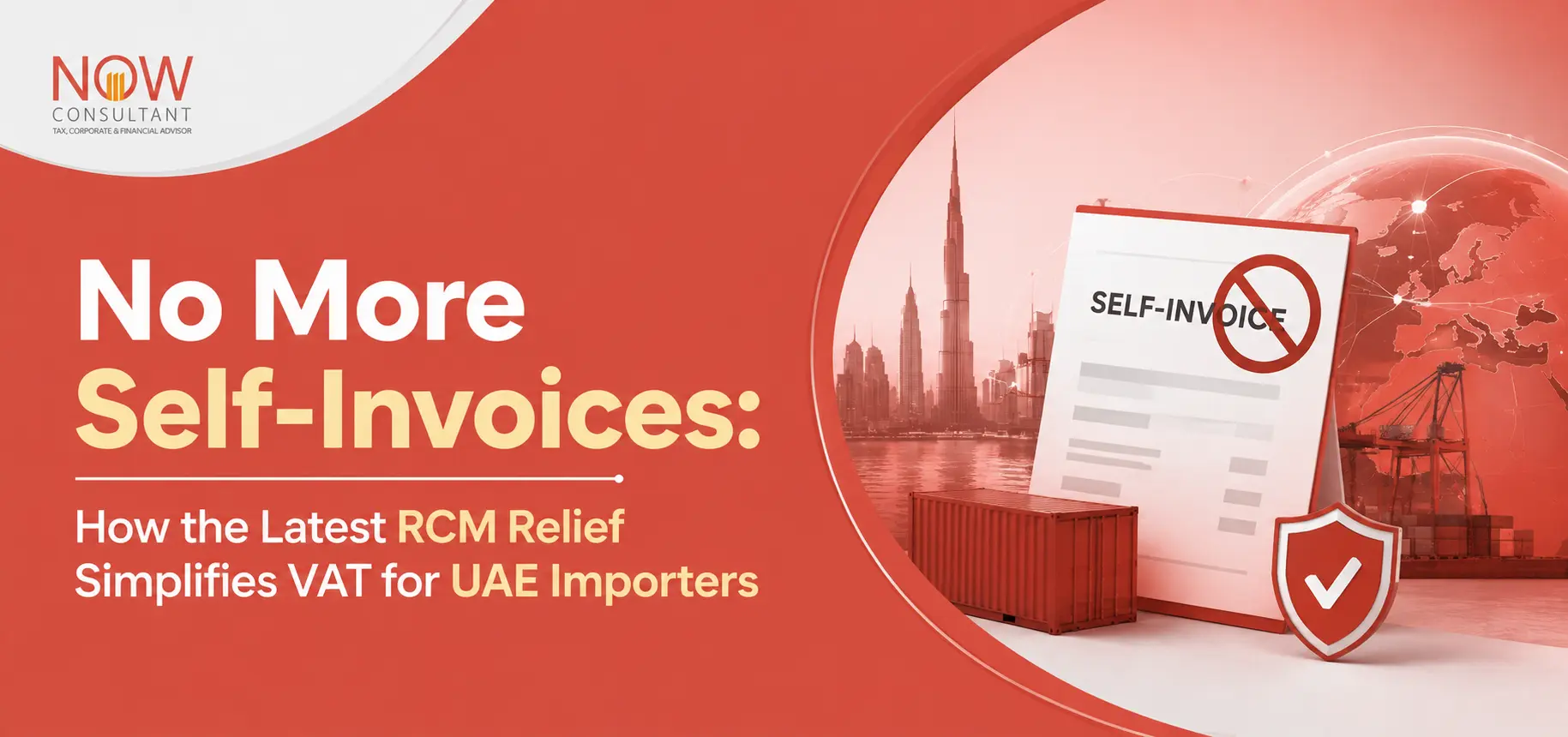
Every importer in the UAE knows the drill. You receive goods from abroad, no VAT invoice comes with them, so you issue one to yourself. It’s called self-invoicing, and it’s been a mandatory step under the reverse charge mechanism UAE for years. This is no longer the case as of 1st January 2026.
While this is not as significant as some of the other amendments to the VAT services regime in 2026, it will take an important administrative burden off the shoulders of businesses that are regular importers. This article describes what has changed in RCM Relief UAE, what remains the same and where the hidden risk is now.
What Self-Invoicing Used to Require
Under the previous rules, businesses importing goods or services subject to reverse charge had to issue a tax invoice to themselves for VAT reporting purposes. This wasn’t optional. It applied on top of accounting for the VAT correctly in the return. For businesses importing frequently, this meant a steady stream of extra paperwork that added no real value beyond ticking a compliance box.
Many finance teams treated this step as pure friction. The VAT treatment itself, output VAT declared and input VAT reclaimed in the same return, didn’t depend on the self-invoice. It just added another document to generate and file.
What Changed on 1 January 2026
The self-invoicing removal UAE applies to reverse charge transactions, including imports of both goods and services. Businesses no longer need to issue that internal tax invoice. The core VAT liability and recovery position remain exactly the same. Only the paperwork step disappears.
This is genuine simplification, not a loophole or a reduction in tax owed. The amount of VAT accounted for under reverse charge doesn’t change. What changes is how you prove the transaction happened the way you say it did.
Why the FTA Made This Change
Tax authorities generally try to reduce unnecessary compliance burden where it doesn’t add real oversight value. Self-invoicing had become one of those steps. It duplicated information that was already available through supplier records, contracts, and customs documentation. Removing it streamlines the process without weakening the underlying VAT framework.
This fits a broader pattern in the 2026 amendments. Alongside this change, the UAE also introduced the “should have known” rule on input VAT recovery and a five-year limit on excess VAT credits. These changes are all part of a system that aims to remove low-value documents and increase the focus on real risk areas such as dormant credits and supplier fraud.
What You Still Need to Keep
Removing the self-invoice requirement doesn’t mean removing your record-keeping obligations. Businesses must retain standard supporting evidence instead, including:
- Original supplier invoices
- Import declarations and customs paperwork
- Contracts and purchase orders tied to the transaction
- Payment records confirming the transaction occurred
Since the self-invoice used to serve as a built-in audit trail, that trail now depends entirely on how well these other documents are organized and retained.
The Hidden Catch: Documentation Now Matters More
This is the part many businesses overlook. Without a self-invoice, the FTA leans more heavily on supplier invoice retention and customs declaration records during any review. If those records are incomplete, inconsistent, or hard to retrieve, proving your VAT treatment was correct becomes noticeably harder.
This connects directly to the new rule allowing the FTA to deny input VAT recovery UAE where a transaction is linked to tax evasion and the buyer should reasonably have known. Weaker documentation doesn’t just slow down an audit. It can now directly affect whether input VAT gets denied.
Who Benefits Most From This Relief
The administrative saving scales with import volume. A few groups see the clearest benefit:
- Businesses importing goods regularly from overseas suppliers
- Companies receiving cross-border services subject to reverse charge
- Free zone distributors managing high transaction counts through Designated Zones
- Finance teams previously spending real time generating and filing self-invoices each period
For lower-volume importers, the change is welcome but modest. For high-volume traders, it removes a meaningful chunk of recurring compliance work.
How to Adjust Your VAT Process
A few practical steps make the transition smooth:
- Update your VAT process documentation to remove the self-invoicing step from internal procedures.
- Strengthen supplier invoice filing, since these records now carry more evidentiary weight on their own.
- Centralize import and customs paperwork so it’s retrievable quickly if the FTA requests it.
- Brief your team on the change, since old habits around self-invoicing can persist even after the requirement is gone.
- Review your reverse charge transactions periodically to confirm VAT treatment remains correct without the old paperwork checkpoint.
Market Reaction So Far in 2026
Feedback from businesses and advisors since January has been broadly positive. Import-heavy sectors, including trading, distribution, and manufacturing, report a real drop in monthly compliance workload. At the same time, several advisory firms have flagged the documentation point above as the change’s real fine print. The relief is administrative.
The verification standard used behind it has actually tightened, not loosened. A handy reminder that the process of simplifying is not the process of ignoring and not looking. One went down. The other went up.
Final Thoughts
Removing self-invoicing is a genuine, welcome simplification for UAE importers. It cuts recurring paperwork without changing how much VAT is owed or recovered. But the businesses getting the most value from this change are the ones treating it as a reason to tighten their document retention, not loosen it.
Reliable accounting services in Dubai can help you rebuild your reverse charge process around the new rules, making sure supplier and import records are complete before an audit ever asks for them. Firms offering outsourced accounting services are well placed to manage this transition, since ongoing financial reporting naturally keeps import documentation current rather than scrambled together at year-end. A good tax consultant Dubai can also review your existing reverse charge transactions to confirm nothing was missed during the switch, backed by proper accounting supervision services over the records that now matter most.
Now Consultant works with UAE importers on exactly this kind of transition, combining accounting and advisory services with practical VAT process reviews, so the paperwork gets simpler without the compliance risk quietly getting harder.